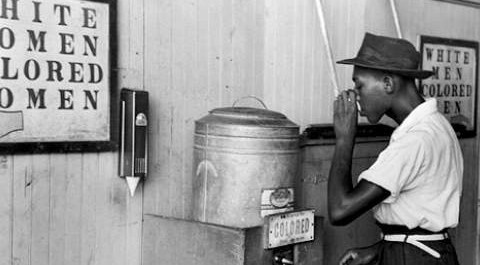
What do you get when you add American slavery, the convict-lease system, the Jim Crow era, and the “War on Drugs”? Give up? You get 150+ years of nearly uninterrupted mistreatment of young, African American men at the hands of businesses, individuals and various governmental agencies in the United States. You get ongoing racial profiling in cities like New York. We in hallowed suburbia who see the brutality of slavery and the lynchings and “coloreds only” water fountains of Jim Crow only in an ever dustier rear-view mirror are perhaps ignorant of the current realities. Those who are ignorant of the multi-decade convict lease system in the South are in our own good company: we know little and most of our friends know less. (I interviewed Douglas Blackmon, Pulitzer prize-winning author of Slavery by Another Name, in this series: Part 1, Part 2, Part 3, and Part 4.) Subtitled “Mass Incarceration in the Age of Colorblindness”, The New Jim Crow takes its name from the condition author Alexander sees exemplified, for instance, in the massive government effort knows as the War on Drugs. This “war” has been so disproportionately prosecuted that a disproportionately large percentage of one specific demographic section of the U.S. population is either imprisoned, on probation or parole: African-American men. Alexander’s case is built brick-by-brick as she examines policing, the court system, laws like Civil Asset Forfeiture, abuses of the Constitution and the favoritism shown to white defendants. She writes: The United States imprisons a larger percentage of its black population than South Africa did at the height of apartheid. In Washington, D.C., our nation’s capitol, it is estimated that three out of four young black men (and nearly all those in the poorest neighborhoods) can expect to serve time in prison. Similar rates of incarceration can be found in black communities across America. These stark racial disparities cannot be explained by rates of drug crime. Studies show that people of all colors use and sell illegal drugs at remarkably similar rates. If there are significant differences in the surveys to be found, they frequently suggest that whites, particularly white youth, are more likely to engage in drug crime than people of color. That is not what one would guess, however, when entering our nation’s prisons and jails, which are overflowing with black and brown drug offenders. In some states, black men have been admitted to prison on drug charges at rates twenty to fifty times greater than those of white men. And in major cities wracked by the drug war, as many as 80 percent of young African American men now have criminal records and are thus subject to legalized discrimination for the rest of their lives. (pgs. 6, 7) Aiding and abetting this treatment are prosecution and sentencing requirements mandated by War on Drugs styled legislation like “Three Strikes and You’re Out.” In 1986, Congress passed The Anti-Drug Abuse Act, which established extremely long mandatory minimum prison terms for low-level drug dealing and possession of crack cocaine. The typical mandatory sentence for a first-time offense in federal court is five or ten years. By contrast, in other developed countries around the world, a first-time offense would merit no more than six months in jail, if jail time is imposed at all. […] Now, simply by charging someone with an offense carrying a mandatory sentence of ten to fifteen years or life, prosecutors are able to force people to plead guilty rather than risk a decade or more in prison…They “load up” defendants with charges than carry extremely harsh sentences in order to force them to plead guilty to lesser offenses and–here’s the kicker–to obtain testimony for a related case. Harsh sentencing laws encourage people to snitch. […] In fact, under federal sentencing guidelines, providing “substantial assistance” [ie, “snitching”] is often the only way defendants can hope to obtain a sentence below the mandatory minimum. The “assistance” provided by snitches is notoriously unreliable, as studies have documented countless informants who have fabricated stories about drug-related and other criminal activity in exchange for money or leniency in their pending criminal cases. (pgs. 87, 88) Add to this unholy mix laws that increase federal assistance based on number of drug-related arrests, inadequate representation from the public defender’s office, warrantless searches and the like, and you have a never ending pool of “violators” into which to cast the net. (For additional contributing factors like race and the Prison Industrial Complex, see my series Our comfortable injustice Part 1 and Part 2.) Alexander’s chapter “The Color of Justice” is particularly disturbing. In a passage on the New York Police Department’s use of “stop-and-frisk” tactics–which should be unconstitutional–she quotes the Center for Constitutional Rights’ Darius Chaney, “[W]e have been saying for the last 10 or 11 years…that with stop-and-frisk patterns–it really is race, not crime, that is driving this.” Alexander concludes, Ultimately, these stop-and-frisk operations amount to much more than humiliating, demeaning rituals for young men of color, who must raise their arms and spread their legs, always careful not to make a sudden move or gesture that could provide an excuse for brutal–even lethal–force. Like the days when black men were expected to step off the sidewalk and cast their eyes downward when a white woman passed, young black men know the drill when they see the police crossing the street toward them; it is a ritual of dominance and submission played out hundred of thousands of times each year. (p. 136) It should raise concerns for followers of Christ not only because of the actual injustices faced by African-Americans but for the mindsets Americans have about such injustices. From page 106: A survey was conducted in 1995 asking the following question: “Would you close your eyes for a second, envision a drug user, and describe that person to me?” The startling results were published in the Journal of Alcohol and Drug Education. Ninety-five percent of respondents picture a black drug user, while only 5 percent imagined other racial