
Definitely worth one minute thirty seconds.
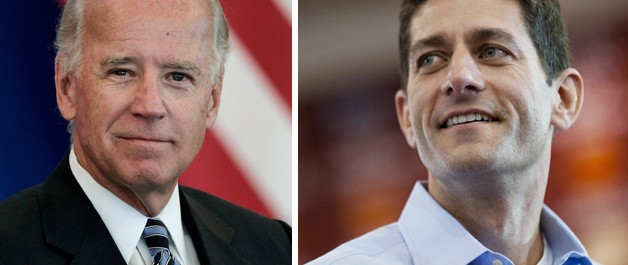
Live Chat the Biden-Ryan Vice-presidential debate (VP debate)
Welcome to the Kingdom in the Midst Live Chat for the Joe Biden-Paul Ryan vice-presidential debate. Vice President Biden and the man on the Republican ticket, Paul Ryan, will be debating the issues in a 90-minute session at Centre College in Danville, Ky. The event begins at 9:00ET. Below you can login with either your Facebook or Twitter accounts, or simply choose a “Guest” username and login to participate. RULES 1. Be clear. 2. Stay on topic. Romney/Ryan and Obama/Biden, their policies and performances are inbounds. Their families are not. 3. Try to be concise. If you try to write a novel the comment to which you are responding will be gone. 4. When appropriate use the name of the person to whom you are responding. For instance, “Terminator1: I think you are misinformed.” 5. NO SWEARING. If you cannot express yourself without stooping to gutter language go back to the SPIKE movie you were watching. 6. Please share the post via social sharing buttons at the top. The more the merrier. 7. Have fun! Chat is closed.

Who are America’s poor?
An October 7, 2012 cover story in the Christian Science Monitor explores the issue of America’s poor. The provocative article is entitled “Below the line: Poverty in America.” Correspondent Jina Moore explores via narrative, history and facts what it means to be poor in America. Or at least what some people claim about poverty, and a few who reject the term. She writes: [Who is poor] turns out to be a very difficult question to answer. How you answer may depend as much on who you are – liberal or conservative, city-dweller or rural homesteader, low-wage laborer or salaried middle class – as on any single set of criteria. Even the government isn’t sure how to think about the question: In some states, making $1,000 a month might qualify you for food stamps but could be too much income to qualify for Medicaid. A presidential election year only makes the issue of the haves and have-nots more divisive. President Obama took heat for admonishing entrepreneurs that their businesses relied on tax-supported infrastructure and that “You didn’t build that.” Republican candidate Mitt Romney has been caught up in controversy over his statements at a fundraiser that nearly half of Americans don’t pay income tax and “feel entitled” to government “handouts.” Americans know poverty exists and may agree on its broadest outlines, but when it gets down to the specifics, they often can’t agree on exactly who “the poor” are. Among the stories she tells is one of Linda, who steals her fruit. No one at King’s Daughters Day Care, where she works, would begrudge her an orange or an apple, of course. This isn’t that kind of workplace. When she grabs a piece of whatever the kids are having that day, she’s welcome to it. But the simple staple is also something she can’t buy on her own. “I can’t afford fresh fruit or low-fat meat. I can’t get cauliflower or green peppers,” she says. When she does buy food, “I buy things that stretch longer.” She opts for whole roasted chickens that she spins into four or five meals. She can stretch a tomato, grown in her home garden, across an afternoon salad and an evening BLT sandwich. Until the first frosts come, and the plants die, that is. Then she waits until summer to eat tomatoes again. Ms. Criswell’s stoic self-sufficiency isn’t always enough to get her through. “I’ve eaten food that’s seven, 10 days old.” She gestures toward a reporter’s notebook. “You can [write] that down.” Criswell works full time, with no benefits, and she hasn’t had a raise in three years. After taxes, she brings home $1,030 a month – enough, if she’s careful, to meet her expenses, with little wiggle room. “What I feel,” she says, “is anxiety. I felt it just this morning. It’s constantly in the back of my mind: ‘Am I going to have enough to pay the bills?’” The “poor” in America are not stereotypical no matter what stereo one might wish to type. The inhabitants of poverty are as deep and wide as the stories that comprise the government’s numbers. An enormous number of those in poverty work. Many of them work full time. Many others want to work, but cannot find the jobs. And, new estimates tell us, the high paying jobs are not coming back any time soon. This means, to paraphrase one Jesus Christ, “The poor will be with us always.” Moore’s article continues: Peter Edelman, a former Clinton administration official and now director of the Center on Poverty, Inequality and Public Policy at Georgetown University in Washington, D.C., agrees: “There are literally millions of people … out there working … not getting out of poverty.” He says the numbers show that there are “people who are in low-wage jobs and get some income supplement. Nobody wants to really admit that’s going on.” In fact, most of the new jobs seen since the economic crisis – and most of what will come in the next decade – are low-wage, according to the National Employment Law Project. More than 40 percent of the jobs added to the economy between 2008 and 2010 – the first two years of the recession – were low-wage jobs, the project reported in August. Six of the 10 jobs projected to see the most growth by 2020 are also low-wage jobs. Most people outside of Washington, DC, realize the current “recovery” is itself on life support. We are currently financing not only our own faux-recovery, but helping float the world’s economy. Likely this attempt will continue suppressing our own economy. John Shmitt and Janelle Jones of the Economic Policy and Research Center found in their September 2012 paper, “Bad Jobs on the Rise,” [W]e define a bad job as one that pays less than $37,000 per year (in inflation-adjusted 2010 dollars); lacks employer-provided health insurance; and has no employer-sponsored retirement plan. By our calculations, about 24 percent of U.S. workers were in a bad job in 2010 (the most recently available data). The share of bad jobs in the economy is substantially higher than it was in 1979, when 18 percent of workers were in a bad job by the same definition. In other words, if you are a single-income family of four with $37,000 per year salary, paid health insurance and some kind of 401(k) or other retirement, you are considered by Shmitt and Jones to have a good job. Personally when I think of that scenario, I think of “working poor.” Remember Linda? Jina Moore asks whether she is poor: The government says no, because she makes “too much” money [$12,000/yr/net]. Yet if she needs to go to the mall or the grocery store, she hitches rides with her 35-year-old daughter, to save gas. When her brother gives her a gift card to Big Lots, a discount store, for her birthday, she buys towels and toilet paper. While other Americans watch the stock market, she watches the grain prices. Grain feeds
‘Religiously unaffiliated’ on the rise says Pew Research
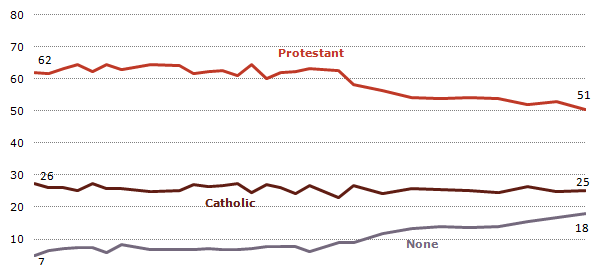
The number of Americans who do not identify with any particular religion continues to increase rapidly according to newly released data from Pew Research. One-fifth of the U.S. public–and about a third of adults under 30–are religiously unaffiliated today, the highest percentages ever in Pew Research Center polling. In the last five years the unaffiliated have increased from just over 15% to just under 20% of all U.S. adults. Among them are more than 13 million self-described atheists and agnostics (nearly 6% of the U.S. public), as well as nearly 33 million people who claim to have no particular religious affiliation. That number represents 14% of the population. What makes this even more troubling for followers or Christ is that 88% of the “nones” are not looking for any kind of religious system. “Overwhelmingly, they think that religious organizations are too concerned with money and power, too focused on rules and too involved in politics,” says Pew. The report continues: While the ranks of the unaffiliated have grown significantly over the past five years, the Protestant share of the population has shrunk. In 2007, 53% of adults in Pew Research Center surveys described themselves as Protestants. In surveys conducted in the first half of 2012, fewer than half of American adults say they are Protestant (48%). This marks the first time in Pew Research Center surveys that the Protestant share of the population has dipped significantly below 50%. The decline is concentrated among white Protestants, both evangelical and mainline. Currently, 19% of U.S. adults identify themselves as white, born-again or evangelical Protestants, down slightly from 21% in 2007. And 15% of adults describe themselves as white Protestants but say they are not born-again or evangelical Christians, down from 18% in 2007. There has been no change in minority Protestants’ share of the population over the past five years. Thinking about the religiously unaffiliated people you know, what are their reasons for not seeking God? Or, is it God they seek outside of a religious connection?
Failed prophecies from ‘Focus’
In October of 2008 the Focus on the Family organization published the “Letter from 2012 in Obama’s America.” As you might imagine it was not friendly to the then-candidate for the presidency. Sixteen pages long with 34 separate prediction points Focus laid out in deep, horrifying detail how the U.S would look in 2012. How did they do? Look at it this way: the oft cited Old Testament standard for prophetic accuracy was 100%. A single errant prophecy would sound the end-of-life bell for the so-called prophet. If we were still under the Mosaic law it would be time to load up the rocks and descend on Colorado Springs. A few of the predictions are still up in the air. One of them was half-right. Still others could possibly happen. One or two of Focus’ guesses would likely have happened no matter who was elected. Most, however, were just plain, old-fashioned fear mongering. They are so wrong as to be laughable in retrospect. These have been edited for length, but the original can be read at WND.com. 1. The Boy Scouts no longer exist as an organization. They chose to disband rather than be forced to obey the Supreme Court decision that they would have to hire homosexual scoutmasters and allow them to sleep in tents with young boys. 2. Elementary schools now include compulsory training in varieties of gender identity in Grade 1, including the goodness of homosexuality as one possible personal choice. Many parents tried to “opt out” their children from such sessions, but the courts have ruled they cannot do this, noting that education experts in the government have decided that such training is essential to children’s psychological health. Many Christian teachers objected to teaching first-graders that homosexual behavior was morally neutral and equal to heterosexuality. They said it violated their consciences to have to teach something the Bible viewed as morally wrong. But state after state ruled that their refusal to teach positively about homosexuality was the equivalent of hate speech, and they had to teach it or be fired. Tens of thousands of Christian teachers either quit or were fired, and there are hardly any evangelical teachers in public schools any more. 3. There are no more Roman Catholic or evangelical Protestant adoption agencies in the United States. Following earlier rulings in New York and Massachusetts, the U.S. Supreme Court in 2011 ruled that these agencies had to agree to place children with homosexual couples or lose their licenses. 4. All businesses that have government contracts at the national, state or local level now have to provide documentation of equal benefits for same-sex couples. 5. The Bible can no longer be freely preached over radio or television stations when the subject matter includes such “offensive” doctrines as criticizing homosexual behavior. The Supreme Court agreed that these could be kept off the air as prohibited “hate speech” that is likely to incite violence and discrimination. 6. Physicians who refuse to provide artificial insemination for lesbian couples now face significant fines or loss of their license to practice medicine 7. All other professionals who are licensed by individual states are also prohibited from discriminating against homosexuals. Social workers and counselors, even counselors in church staff positions, who refuse to provide “professional, appropriately nurturing marriage counseling” for homosexual couples lose their counseling licenses. Thousands of Christians have left these professions as a result. 8. Church buildings are now considered a “public accommodation” by the Supreme Court, and churches have no freedom to refuse to allow their buildings to be used for wedding ceremonies for homosexual couples. If they refuse, they lose their tax-exempt status, and they are increasingly becoming subject to fines and antidiscrimination lawsuits. 9. While churches are still free to turn down homosexual applicants for the job of senior pastor, churches and parachurch organizations are no longer free to reject homosexual applicants for staff positions such as parttime youth pastor or director of counseling. 10. In the first week after his inauguration, President Obama invited homosexual rights leaders from around the United States to join him at the White House as he signed an executive order directing all branches of the military to abandon their “don’t ask, don’t tell” policy and to start actively recruiting homosexuals. [Partially true, but….] As a result, homosexuals are now given special bonuses for enlisting in military service (to attempt to compensate for past discrimination) [Sorry, no sexual orientation signing bonuses.] 11. High schools are no longer free to allow “See You at the Pole” meetings where students pray together, or any student Bible studies even before or after school. 12. Tens of thousands of young churches suddenly had no place to meet when the Supreme Court ruled that public schools in all 50 states had to stop allowing churches to rent their facilities — even on Sundays, when school was not in session. 13. Campus organizations such as Campus Crusade for Christ, InterVarsity, Navigators, Baptist Campus Ministry, and Reformed University Fellowship have shrunk to skeleton organizations, and in many states they have ceased to exist. 14. Public school teachers are no longer free to lead students in the Pledge of Allegiance to the flag of the United States. 15. [F]ederal law immediately nullified hundreds of state laws that had created even the slightest barrier to abortion. States can no longer require parental involvement for minors who wish to have an abortion, waiting period, informed consent rules, restrictions on tax-payer funding or restrictions on late-term abortions. The act reversed the Hyde Amendment, so the government now funds Medicaid abortions for any reason. As a result, the number of abortions has increased dramatically. 16. Nurses are no longer free to refuse to participate in abortions for reasons of conscience. 17. Doctors who refuse to perform abortions can no longer be licensed to deliver babies at hospitals in any state. As a result, many Christian doctors have left family medicine and obstetrics, and many have retired. 18. It’s almost impossible to keep
Learning from Turkish Muslims
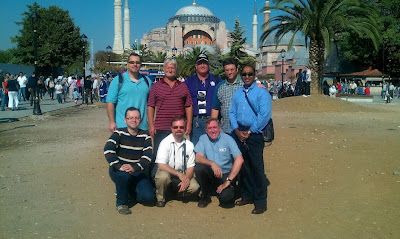
My friend Joel Rainey recently returned from a trip to Turkey. Joel has been a pastor and church planter, is an author, blogger, husband and father. He currently is the Director of Missions for the Mid Maryland Baptist Association. This week he blogged about his trip to the nation of Turkey; a trip he took with several pastors from his area. It is an illuminating story with truths that benefitted me, and I hope will benefit you, too. He has given me to publish, “What Turkish Muslims Taught Me About our Changing World” in its entirety. The original post is at his blog, themelios. My job sometimes requires pretty extensive travel, and through my service to our churches, I’ve had the opportunity to, literally, see the world. But I’ve just returned from a trip that I think has had a greater impact on me than any other trip I’ve taken. From September 21-30, six area pastors and myself traveled throughout the Republic of Turkey with members of the Muslim community. This journey actually started more than a year ago with a call from one of our state legislators who is a member of one of our churches. The Governor of Maryland had included her in a trip to Turkey as part of an eventual “sister-state” agreement that was signed between my state and a province in that country, but once the leader of the Turkish organization discovered that this representative was an evangelical Christian, he expressed hesitation, because, as he put it, “I always thought evangelical Christians hated Muslims.” Seeking to put this false rumor to rest, I reached out to the members of this community, and got a warm embrace in response that has lasted more than a year. I’ve been in the company of people from nearly every tribe and tongue, but when it comes to hospitality, no one does it better than the Turkish people! They are some of the finest and most gracious people I’ve ever met! Eventually, this new relationship resulted in their invitation for us to join them in their home country last week. Let me say that again. Muslims openly invited more than a half dozen Baptist preachers to the middle east, and even covered a significant portion of the cost of the trip! During our time abroad with our new friends, I have never experienced such hospitality! We toured sites together that were important to both Christians and Muslims. We visited schools, newspapers, and hospitals built by this group in the hopes of improving the lives of others in their home country. We visited the homes of influential Turkish business leaders and learned of their own involvement in trying to improve conditions, not only in Turkey, but throughout the middle east. One young pharmacist we met near the border with Syria told me “I want to take what we have done in this city, and spread that peace across the border and throughout this part of the world. I want my city to be the starting gate for peace.” I love that guy’s heart! It is unfortunate that nearly everything about this part of the world that is broadcast on American news media focuses on extremist elements. To be sure, those elements are very present (as was demonstrated after our departure with the Syrian violence crossing the border into Turkey), but the so-called “Muslim world” is full of good people who are trying to make a positive difference, and its working! All of this probably sounds very strange coming from the mouth of an evangelical Christian, and to be sure, my convictions have not changed. I still believe the Bible is the Word of God. I still believe Jesus is God, that He was crucified as a substitute for sinners, that he rose bodily from the dead, and that nothing short of repentance and total faith in His death and resurrection will save. But these convictions don’t hold me back from the relationship I now have with my Muslim friends. On the contrary, they propel me more deeply into relationship with these precious people! This experience is but one example of how the way we engage the world as followers of Jesus needs to change, and I’ve addressed that issue in more depth here. But as we explore further ways to walk together with the Muslim community here, I’m taking several things away from our recent trip that will continue to inform our ongoing relationship. 1. The sincerety of their faith is motivating them to change the world, starting with the region where they live. Our Turkish-American guide for this trip told me that years ago he asked the question, “why is it that when it comes to science and technology, education, and health care, that the Muslim world seems to lag behind everyone else?” According to his own testimony, he found mentors within his own faith who believed that Islam should actively engage all these areas, and contribute to the global community. In short, he and others like him who live in Turkey have found meaning and purpose that they believe is anchored in their faith. 2. The Movement we witnessed in Turkey is cross-generational. While many young people are “out in front” seeming to make positive waves, older generations are seeing their passion and responding with financial support and other things necessary to accomplish their goals. Inspired by Imams of centuries past who encouraged Muslims to invite “outsiders” in, they have taken one step further and are taking the initiative to introduce themselves to the non-Muslim world. They are disheartened by the way the media have focused almost exclusively on the radical elements of their faith, are weary of being automatically identified with those radical elements, and are eager to share the good that is happening throughout the middle east and among Muslims worldwide which is so under-reported. It was not uncommon for us to visit a home where three or four generations of Turkish Muslims spoke of their
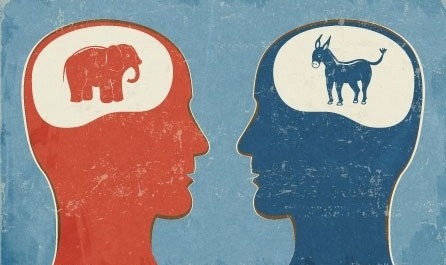
Your guide for tonight’s debate
Tonight the major networks will host a debate between Barack Obama and Mitt Romney. (Third party candidates have been asked to stay home. Upsetting the accepted narrative is frowned upon by the Presidential Debate Commission.) Of these few things you can be sure: 1. Both men will say something good. 2. Both men will make gaffes. 3. Even if Barack Obama falls off the stage, drops an F-bomb, and lights up a Marlboro while talking about healthcare, Democrats will proclaim him the winner within a nanosecond of the host’s “Goodnight and thanks for watching.” 4. Even if Mitt Romney breaks out a roll of thousand dollar bills as thick as Andre the Giant’s fist, introduces his two other wives to America, and calls for dispersing the Social Security Trust Fund among the Forbes 400, Republicans will shout down the Democrats in proclaiming a win. 5. Both men will be unswervingly bold in their promises and incomprehensibly vague in their substance. 6. Mitt Romney will say Obama has gotten almost nothing right. 7. Barack Obama will say Romney would get almost nothing right. 8. Obama will say “47%” enough times for an entire frat house to be drunk from beer pong. 9. Romney will mention “unemployment” enough times for Joe Biden to realize his four year burden comment was actually a slam on his boss. 10. No Democrats will change their minds. 11. No Republicans will change their minds. 12. Anyone who decides to vote based on a debate should probably have their voter registration card revoked. Good night, and good luck.
African-American responses to Propaganda’s ‘Precious Puritans’
For no particular reason I have never been a fan of rap or hip-hop, but last week I was drawn into that genre. The fellow responsible for the drawing is an artist known as Propaganda, a self-described “fire baptized, battle rapper, who’s heavily influenced by boat music and bound creative freedom in poetry.” At least I think that’s what he says. The song by which I was drawn is called “Precious Puritans.” The song, from Propaganda’s new project, Excellence, takes pastors to task for uncritically quoting the theology of many Puritan pastors. These would be the same Puritans who owned and abused slaves, while excusing it as the order of things. The lyrics to the song (below) are blistering, insightful, and revealing. Chicago area pastor Joe Thorn brought the song into my field of view with two posts on his blog. The first is an interview with historian and author Dr. Richard Bailey, professor of early American history at Canisius College, and author of Race and Redemption in Puritan New England, (OUP, 2011). The second is an interview with Propaganda, with a lengthy discussion about the song. In short order a twitter exchange broke out with Owen Strachan taking the position the song went too far and would possibly cause avoidance of Puritans altogether. Like not enough fiber in ones diet, I suppose. Last week Strachan took to his blog with the same assertions. It was a weak attempt at a critique. If anything Strachan demonstrated with sterling clarity the very mindset challenged by Propaganda. Next, influential blogger Steve McCoy weighed-in. McCoy is well known for his breadth of musical knowledge and affirmation of the arts. He correctly notes too many people have missed the point of “Precious Puritans.” I could not agree more. Today Steve asks, “Where are the voices of our white, Puritan-loving Southern Baptist leaders, and seminary presidents, and deans, and entity leaders, and prominent pastors? We need your voices on this.” It is a needed, important question. I do not fit into any of those categories, but I do have a few thoughts. One, mainly. Where are the white believers who are seeking responses from African-Americans? Why, when issues of race propel themselves to the fore, do so many white folks think a white opinion is all that is needed? Worse, why do we so readily believe that we automatically provide a correct analysis on any racial issue? Today, Dr. Anthony Bradley, associate professor of theology and ethics at The King’s College in New York City and research fellow at the Acton Institute for the Study of Religion and Liberty, tackled the issue on the Urban Faith blog. Addressing this crucial item he writes: Propaganda’s point is that if white evangelicals do not talk about the bones of their heroes they run the risk of doing great harm to people of color. Many of us are beginning to wonder why white evangelicals do not seem to care much about this and seem willing to trade off “honoring” their forefathers for their own comfort over doing what is necessary to build racial solidarity. Some of my liberation theology friends, in the end, would see Strachan’s critique as a dismissal of acknowledging the importance of caring about how the Puritans are presented to African Americans and would constitute a racial microaggression or a micro-invalidation. There is an ongoing disconnect between most white evangelicals and anything to do with minority culture, especially as it relates to African-American culture. We are so blind and insular that we do not even attempt bridging divides. This is not typically out of hate, but because we know of no such divide. Were the slaves not freed? Was the Voting Rights Act not passed? Was the Civil Rights Act not passed? Do we not have a president who is African-American? Then, what is the fuss? Such is a typical white line of thinking. Two of my African-American pastor friends took the time to respond with their thoughts on “Precious Puritans.” James Roberson III is the Missional Communities Pastor at Blueprint Church in Atlanta, GA. Dr. Dwight McKissic is the Senior Pastor of Cornerstone Baptist Church in Arlington, TX. From James Roberson: Here are some historical facts that aren’t talked about: George Whitfield campaigned to have slaves at his orphanage. Jonathan Edwards owned slaves as well. The Southern Baptist Convention made negro inferiority a theological conviction amongst its convention. Did these negative attributes define who these people were? Not in my opinion. But I wonder if the issue was abortion? What if George Whitfield campaigned for the rights of women to have abortions. Jonathan Edwards owned abortion clinics. The Southern Baptist Bonvention made a woman’s right to choose a theological conviction amongst its convention. I have heard abortion and slavery compared on more than one silly occasion so I figured I would use it here. I think abortion would make us think of these folks very differently. It shows how we value certain issues more than others. I love what Propaganda said in his album and I’m surprised that he hasn’t received more flack than he has. Prop was right. I think the entirety of the poem speaks to the flaws of all leaders, which is a healthy reminder. But what I think we are unwilling to embrace is that white people are far too often tired of the slavery conversation and want to move on. I understand that many white people feel like they shouldn’t have to discuss something they weren’t apart of. Yet what we should embrace is that humans were once used like a rake or luggage; nothing but tools. Black people were considered three-fifths of a human and made white people a fortune. A fortune that many whites have gained a considerable amount of privilege from. It would only be healthy to consistently take a look at how we actually thought God was ok with that. It would also be a benefit to our missiology within cities to understand how
The drone war and the kingdom of God
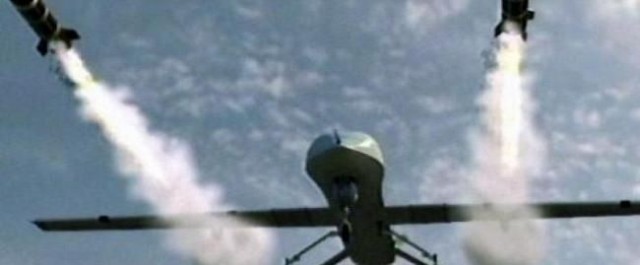
A week or so ago results from a recent in-depth investigative report on America’s drone war were released. Despite horrid reviews for President Obama’s involvement in it, several “mainstream” news outlets reported the findings. A CNN report entitled Drone strikes kill, maim and traumatize too many civilians, U.S. study says states The report accuses Washington of misrepresenting drone strikes as “a surgically precise and effective tool that makes the U.S. safer,” saying that in reality, “there is significant evidence that U.S. drone strikes have injured and killed civilians.” It also casts doubts on Washington’s claims that drone strikes produce zero to few civilian casualties and alleges that the United States makes “efforts to shield the drone program from democratic accountability.” When I wrote about drones in September (“One former British soldier talks about drone warfare”) a linked Washington Post story revealed 92 U.S. drone attacks from January 2011-June 2012 resulted in only five Al Queda leaders being killed. That is 87 misses out of 92 tries. “Misses” being qualified by saying many people have been killed or injured, just not so much the actual enemy. The surgical precision about which our government likes to brag is akin to using a chainsaw to take out an appendix. The scars being about equal. In the second of his two broadsides on why he will not vote for either major party candidate, Atlantic staff writer, Conor Friedersdorf, notes this about drone warfare: Obama terrorizes innocent Pakistanis on an almost daily basis. The drone war he is waging in North Waziristan isn’t “precise” or “surgical” as he would have Americans believe. It kills hundreds of innocents, including children. And for thousands of more innocents who live in the targeted communities, the drone war makes their lives into a nightmare worthy of dystopian novels. Forgive me, but the word “terrorizes” is tellingly ironic. Mitt Romney, the Republican nominee, can be expected to dial up the hubris meter during the election approach. He may even hit 11. To fire up his base he must demonstrate he is even tougher on terrorism than Obama, which, following the most recent 9/11, should not be difficult. But Romney has offered no indication he would scale back the targeted killing program Predators provides. Just yesterday, October 1, 2012, a Washington, DC, CBC affiliate reported drones will soon be able to seek and destroy on the battlefield without human input. Ronald Arkin, a professor at the Georgia Institute of Technology, believes that drones will soon be able to kill enemies on their own independently. “It is not my belief that an unmanned system will be able to be perfectly ethical in the battlefield, but I am convinced that they can perform more ethically than human soldiers are capable of,” Arkin told AFP. Arkin added that robotic weapons should be designed as “ethical” warriors and that these type of robots could wage war in a more “humane” way. And we thought Skynet was so far in the future. Dutifully the military asserts humans will remain involved in drone manipulation, that they will not be autonomous. And we are expected to to believe the military without question. Because the military never lies and the government never participates in cover-ups. Right. This post, however, is not primarily concerned with the politics involved with the drone war. My concern is the relationship of its effects to the kingdom of God. We have been told that drone warfare provides safety to American troops and provides for less collateral damage than other types bombing. Drones are able to provide visuals clearer than a set of latitude and longitude coordinates, I suppose. A Hellfire missile launched from a drone should cause fewer casualties than a Tomahawk fired from a ship. Cleaner shots, better identification, direct hits. All of this adds up to more dead terrorists and a better protected homeland. Except it doesn’t. The Bureau of Investigative Journalism in London, reports, from June 2004 through mid-September 2012, available data indicate that drone strikes killed 2,562-3,325 people in Pakistan, of whom 474-881 were civilians, including 176 children. TBIJ reports that these strikes also injured an additional 1,228-1,362 individuals. Where media accounts do report civilian casualties, rarely is any information provided about the victims or the communities they leave behind. This report includes the harrowing narratives of many survivors, witnesses, and family members who provided evidence of civilian injuries and deaths in drone strikes to our research team. It also presents detailed accounts of three separate strikes, for which there is evidence of civilian deaths and injuries, including a March 2011 strike on a meeting of tribal elders that killed some 40 individuals. Also noted in the report is whenever men of fighting age are killed, even if they are completely unknown, and even if their activity is undefined, they are classified as combatants. That is, if a Hellfire missile lands in the middle of 20 sixteen to eighteen year olds playing soccer, they are classified as enemy combatants. Why? Because we killed them in the course of prosecuting a war. Not because they have been or are in a training camp or have plans to join Al Queda. A quick review: How do we know they were enemy combatants? Because the government said so. How does the government know they were enemy combatants? Because we killed them. They might as well be since, as the NYT reports, “some in the Obama administration joke that when the CIA sees ‘three guys doing jumping jacks,’ they think it is a terrorist training camp.” Very funny. The drone war in Asia and the Middle East has become the “War on Terror” equivalent of the bombing of Laos and Cambodia during the Vietnam War. As if this were not enough our drone strategy includes the very behaviors for which we would condemn terrorists: double strikes. Drones hover twenty-four hours a day over communities in northwest Pakistan, striking homes, vehicles, and public spaces without warning. Their presence terrorizes men, women, and children, giving